Home
/
PH1730
Photographs: PH1730
Title
Ivan Mikhailovich Moskvin as Fedor
Subject
Artist
Fischer, Karl
Date
1911
Dimensions
height: 13.8cm
width: 8.7cm
width: 8.7cm
Provenance
Presented by Michael Gaunt, September 2023.
Other number
E0146
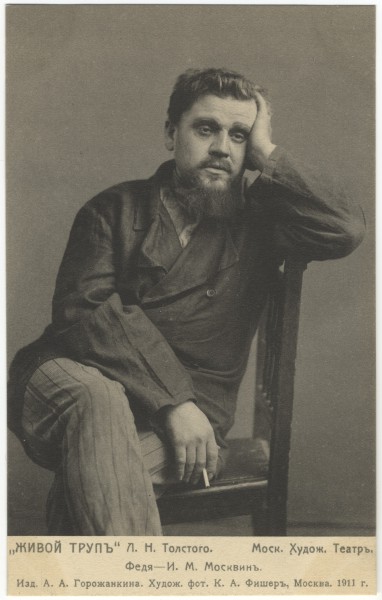
This postcard depicts Ivan Mikhailovich Moskvin in the role of Fedor Protasov in Leo Tolstoy's play 'The Living Corpse'.
Moskvin was an early member of the Moscow Art Theatre (MAT), which was formed in 1898. The actor Konstantin Stanislavski and his co-founder, the writer and drama teacher, Vladimir Nemirovich-Danchenko, wanted to break away from the state-run theatres, bring back high standards and professionalism in acting, and strive towards emotional truth and realism in their performances. Leo Tolstoy wrote ‘The Living Corpse’ in 1900 but it was published after his death in 1910. It was staged by MAT on 5 October 1911 and was the second of two plays by Tolstoy that the company produced.
‘The Living Corpse’ follows the story of Fedor Protasov, who fakes his own death to escape his unhappy marriage. His wife, believing he has died marries her lover. Protasov then meets Masha a gypsy singer and starts a relationship with her. When his true identity comes to light, his wife is taken to court and charged with bigamy. To relieve himself of the guilt he feels for lying to his wife, he shoots himself, becoming no longer a living corpse but a real one.
Moskvin sits on a chair, he wears a black double breasted suit jacket, striped trousers, his right hand holds a cigarette, his head rests in his left hand, and he looks to the side with a despondent expression. It possibly references the opening of Act V Scene 1, when Fedor sits at a table in a restaurant with Petushkóv, an artist, both are drunk and Fedor looks dishevelled.
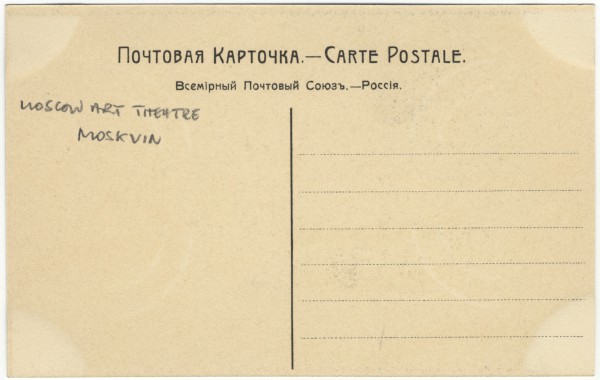
The postcard was published by A. A. Gorozhankin and the photo was taken by Karl Fischer, a prominent German-born Russian photographer who was the official photographer for Imperial Theatres between 1892-1915.
Moskvin was an early member of the Moscow Art Theatre (MAT), which was formed in 1898. The actor Konstantin Stanislavski and his co-founder, the writer and drama teacher, Vladimir Nemirovich-Danchenko, wanted to break away from the state-run theatres, bring back high standards and professionalism in acting, and strive towards emotional truth and realism in their performances. Leo Tolstoy wrote ‘The Living Corpse’ in 1900 but it was published after his death in 1910. It was staged by MAT on 5 October 1911 and was the second of two plays by Tolstoy that the company produced.
‘The Living Corpse’ follows the story of Fedor Protasov, who fakes his own death to escape his unhappy marriage. His wife, believing he has died marries her lover. Protasov then meets Masha a gypsy singer and starts a relationship with her. When his true identity comes to light, his wife is taken to court and charged with bigamy. To relieve himself of the guilt he feels for lying to his wife, he shoots himself, becoming no longer a living corpse but a real one.
Moskvin sits on a chair, he wears a black double breasted suit jacket, striped trousers, his right hand holds a cigarette, his head rests in his left hand, and he looks to the side with a despondent expression. It possibly references the opening of Act V Scene 1, when Fedor sits at a table in a restaurant with Petushkóv, an artist, both are drunk and Fedor looks dishevelled.
The postcard was published by A. A. Gorozhankin and the photo was taken by Karl Fischer, a prominent German-born Russian photographer who was the official photographer for Imperial Theatres between 1892-1915.